

As a supplier of MDF acoustic panels, I often get asked about the sound absorption rate of these panels at different frequencies. Understanding this is crucial for anyone looking to use MDF acoustic panels in various applications, from home theaters to commercial recording studios. In this blog, I'll delve into the science behind the sound absorption of MDF acoustic panels and how it varies across different frequencies.
Understanding Sound Absorption
Before we discuss the sound absorption rate of MDF acoustic panels, let's first understand what sound absorption means. Sound absorption is the process by which sound energy is converted into heat energy when it strikes a material. The sound absorption rate of a material is usually measured as a coefficient, which ranges from 0 to 1. A coefficient of 0 means that the material reflects all the sound energy, while a coefficient of 1 means that the material absorbs all the sound energy.
How MDF Acoustic Panels Work
MDF, or Medium - Density Fiberboard, is a composite material made by breaking down hardwood or softwood residuals into wood fibers. These fibers are then combined with wax and a resin binder and formed into panels under high temperature and pressure. MDF acoustic panels are engineered to have a porous structure that allows sound waves to enter the panel. Once inside, the sound waves are dissipated through friction as they bounce around the pores, converting the sound energy into heat.
Sound Absorption at Different Frequencies
Sound frequencies are typically divided into three main ranges: low frequencies (20 - 200 Hz), mid - frequencies (200 - 2000 Hz), and high frequencies (2000 - 20000 Hz). Each frequency range behaves differently when interacting with MDF acoustic panels.
Low Frequencies
Low - frequency sounds, such as the bass in music or the rumble of traffic, are more difficult to absorb. MDF acoustic panels generally have a lower sound absorption rate at low frequencies. This is because low - frequency sound waves have longer wavelengths, and they require more depth and mass to be effectively absorbed. The relatively thin structure of most MDF acoustic panels makes it challenging for them to trap and dissipate low - frequency sound energy. However, by using thicker MDF panels or combining them with other low - frequency absorbing materials, the absorption rate at low frequencies can be improved.
Mid - Frequencies
MDF acoustic panels perform well in the mid - frequency range. Mid - frequency sounds are the most common in our daily lives, including human voices, most musical instruments, and ambient noise. The porous structure of MDF panels is well - suited to absorb these frequencies. The sound waves can easily penetrate the panel, and the internal pores provide enough surface area for the sound energy to be converted into heat. As a result, MDF acoustic panels can achieve relatively high sound absorption coefficients in the mid - frequency range, often between 0.6 and 0.9.
High Frequencies
High - frequency sounds, such as the hissing of a cymbal or the screeching of a bird, are the easiest to absorb for MDF acoustic panels. High - frequency sound waves have shorter wavelengths, which means they can be more easily trapped in the small pores of the MDF panel. The absorption rate for high frequencies can be quite high, often reaching above 0.9. This makes MDF acoustic panels very effective at reducing high - pitched noise and improving the overall acoustic quality of a space.
Factors Affecting Sound Absorption
Several factors can affect the sound absorption rate of MDF acoustic panels at different frequencies.
Panel Thickness
As mentioned earlier, thicker panels are generally better at absorbing low - frequency sounds. A thicker panel provides more depth for the low - frequency sound waves to penetrate and dissipate. However, increasing the thickness may also increase the cost and weight of the panels.
Panel Density
The density of the MDF panel can also influence its sound absorption properties. Higher - density panels may have fewer and smaller pores, which can reduce the absorption of high - frequency sounds but may improve the absorption of mid - frequency sounds. Lower - density panels, on the other hand, have more and larger pores, which are better at absorbing high - frequency sounds but may be less effective at mid - frequencies.
Installation Method
The way the MDF acoustic panels are installed can have a significant impact on their sound absorption rate. Mounting the panels directly on a wall may reduce their effectiveness, especially at low frequencies. Using an air gap between the panel and the wall can improve the absorption of low - frequency sounds by allowing the sound waves more space to interact with the panel.

Applications of MDF Acoustic Panels Based on Frequency Absorption
The unique sound absorption characteristics of MDF acoustic panels at different frequencies make them suitable for a variety of applications.
Home Theaters
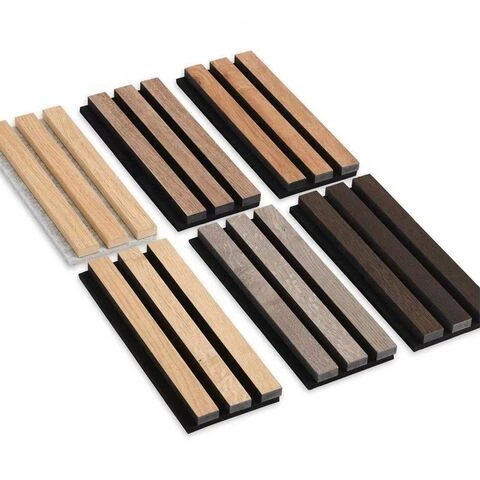
In home theaters, it's important to have good absorption across all frequency ranges. MDF acoustic panels can be used to control high - frequency reflections, which can cause a harsh and bright sound. They can also be combined with other low - frequency absorbing materials to create a more balanced acoustic environment. For example, you can use MDF Acoustic Panel with Wood Veneer to add a touch of elegance to your home theater while improving the sound quality.
Recording Studios
Recording studios require precise control of sound. MDF acoustic panels are often used to absorb mid - and high - frequency sounds, which helps to reduce background noise and create a more isolated recording environment. MDF Acoustic Panel with Technical Veneer can be a great choice for recording studios as they offer both good sound absorption and a professional appearance.
Offices and Conference Rooms
In offices and conference rooms, mid - frequency absorption is crucial for clear communication. MDF acoustic panels can help to reduce the echo and reverberation of human voices, making it easier for people to understand each other. They can also absorb high - frequency ambient noise, such as the hum of computers and the chatter of nearby conversations.
Contact for Purchase and Consultation
If you're interested in using MDF acoustic panels for your project, whether it's a small home improvement or a large commercial installation, I'm here to help. I can provide you with detailed information about the sound absorption rates of our panels at different frequencies, as well as advice on the best panel thickness, density, and installation method for your specific needs. Contact me to start a discussion about your acoustic requirements and explore how our MDF acoustic panels can enhance the sound quality of your space.
References
- Beranek, Leo L. "Acoustics." American Institute of Physics, 1954.
- Crocker, Malcolm J. "Handbook of Noise and Vibration Control." Wiley, 2007.