

Do MDF acoustic panels absorb low - frequency sounds?
Hey there! I'm a supplier of MDF acoustic panels, and I often get asked this question: Do MDF acoustic panels absorb low - frequency sounds? It's a crucial query, especially for those looking to create the perfect acoustic environment, whether it's a home theater, a recording studio, or a large commercial space.
Let's first understand what MDF acoustic panels are. MDF stands for Medium - Density Fiberboard. It's made by breaking down hardwood or softwood residuals into wood fibers, often in a defibrator, combining it with wax and a resin binder, and forming panels by applying high temperature and pressure. MDF is known for its smooth surface, uniform density, and relatively high strength.
Now, let's talk about sound absorption. Sound is basically a wave that travels through the air. When it hits a surface, three things can happen: it can be reflected, transmitted, or absorbed. Sound absorption is all about converting the sound energy into heat energy. Different materials are better at absorbing different frequencies of sound.
Low - frequency sounds, typically in the range of 20 - 200 Hz, are a bit of a challenge when it comes to absorption. These sounds have long wavelengths and are more difficult to trap compared to high - frequency sounds (2000 - 20000 Hz). High - frequency sounds have shorter wavelengths and are more easily absorbed by many common materials.
MDF acoustic panels, on their own, are not the best at absorbing low - frequency sounds. The nature of MDF means that it has a relatively dense and solid structure. Low - frequency sound waves tend to pass through or bounce off such dense materials rather than being absorbed. When a low - frequency sound wave hits an MDF panel, a large portion of the energy is reflected back into the room.
However, that doesn't mean MDF acoustic panels are completely useless for low - frequency absorption. There are ways to enhance their low - frequency absorption capabilities. One common method is to use them in combination with other materials. For example, placing an MDF acoustic panel in front of a layer of acoustic insulation, like fiberglass or mineral wool. The insulation acts as a buffer and helps to break up the low - frequency sound waves, allowing more of the energy to be absorbed.
Another approach is to design the MDF acoustic panels in a specific way. For instance, creating perforated MDF panels. The holes in the panels allow the sound waves to enter the panel and interact with the air inside, increasing the chances of absorption. By adjusting the size, spacing, and depth of the perforations, we can fine - tune the absorption characteristics of the panels to better target low - frequency sounds.
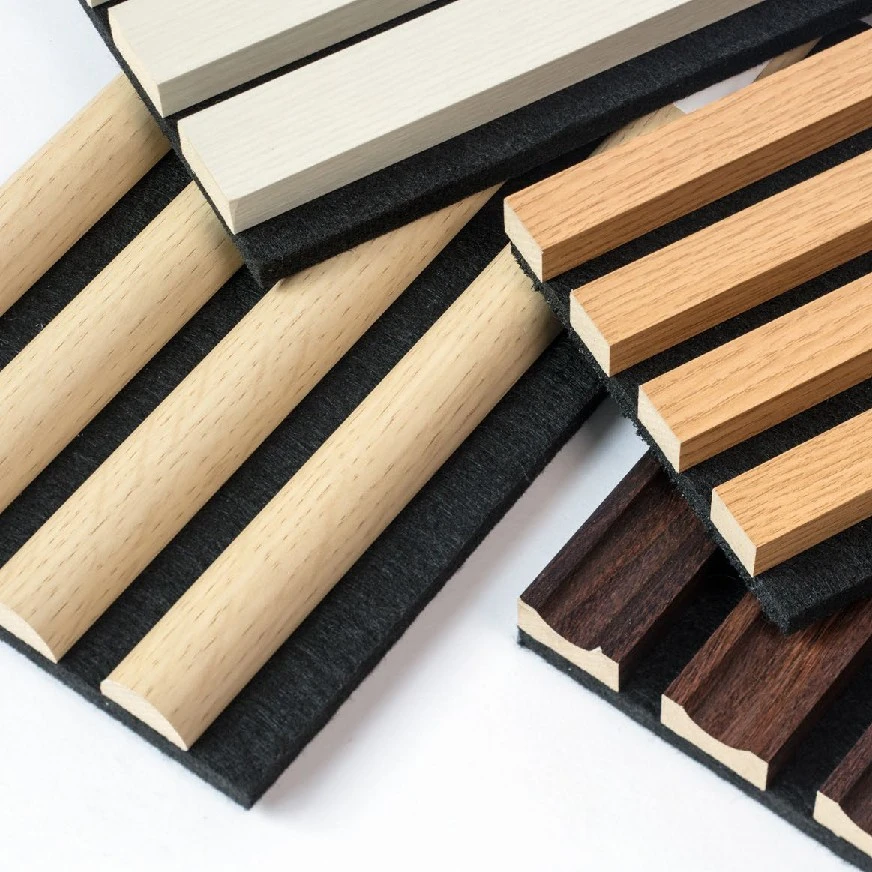
At our company, we offer a variety of MDF acoustic panels, including MDF Acoustic Panel with Technical Veneer and MDF Acoustic Panel with Wood Veneer. These panels not only look great but can also be customized to improve low - frequency absorption. We can work with you to determine the best configuration based on your specific acoustic needs.
When it comes to real - world applications, the effectiveness of MDF acoustic panels for low - frequency absorption also depends on the size and shape of the room. In a small room, low - frequency sounds can build up quickly, creating standing waves and resonance. Using properly designed MDF acoustic panels can help to reduce these issues, but it might require a more comprehensive acoustic treatment plan.
In a large commercial space, such as a concert hall or a conference room, low - frequency control is even more critical. Our MDF acoustic panels can be part of a larger system that includes bass traps and other specialized acoustic elements. By strategically placing the panels around the room, we can create a more balanced acoustic environment.
So, to answer the question, MDF acoustic panels don't have a high natural ability to absorb low - frequency sounds. But with the right design and combination with other materials, they can play a significant role in low - frequency sound management.
If you're in the market for MDF acoustic panels and want to discuss how we can help you with your low - frequency sound absorption needs, don't hesitate to reach out. We're here to provide you with the best solutions and ensure that your acoustic project is a success.

References:
- Beranek, Leo L. "Acoustics." American Institute of Physics, 1986.
- Kuttruff, Heinrich. "Room Acoustics." Spon Press, 2009.
- Rossing, Thomas D. "The Science of Sound." Addison - Wesley, 2001.